
EV battery & insurance guide
Does insurance cover EV batteries?
An EV battery is part of the vehicle, but that does not mean every battery problem is an insurance claim. The key questions are what caused the damage, what your policy covers, whether an exclusion applies and whether the issue is instead a warranty, maintenance or consumer-law matter.
The short answer
Battery damage and battery degradation are different problems
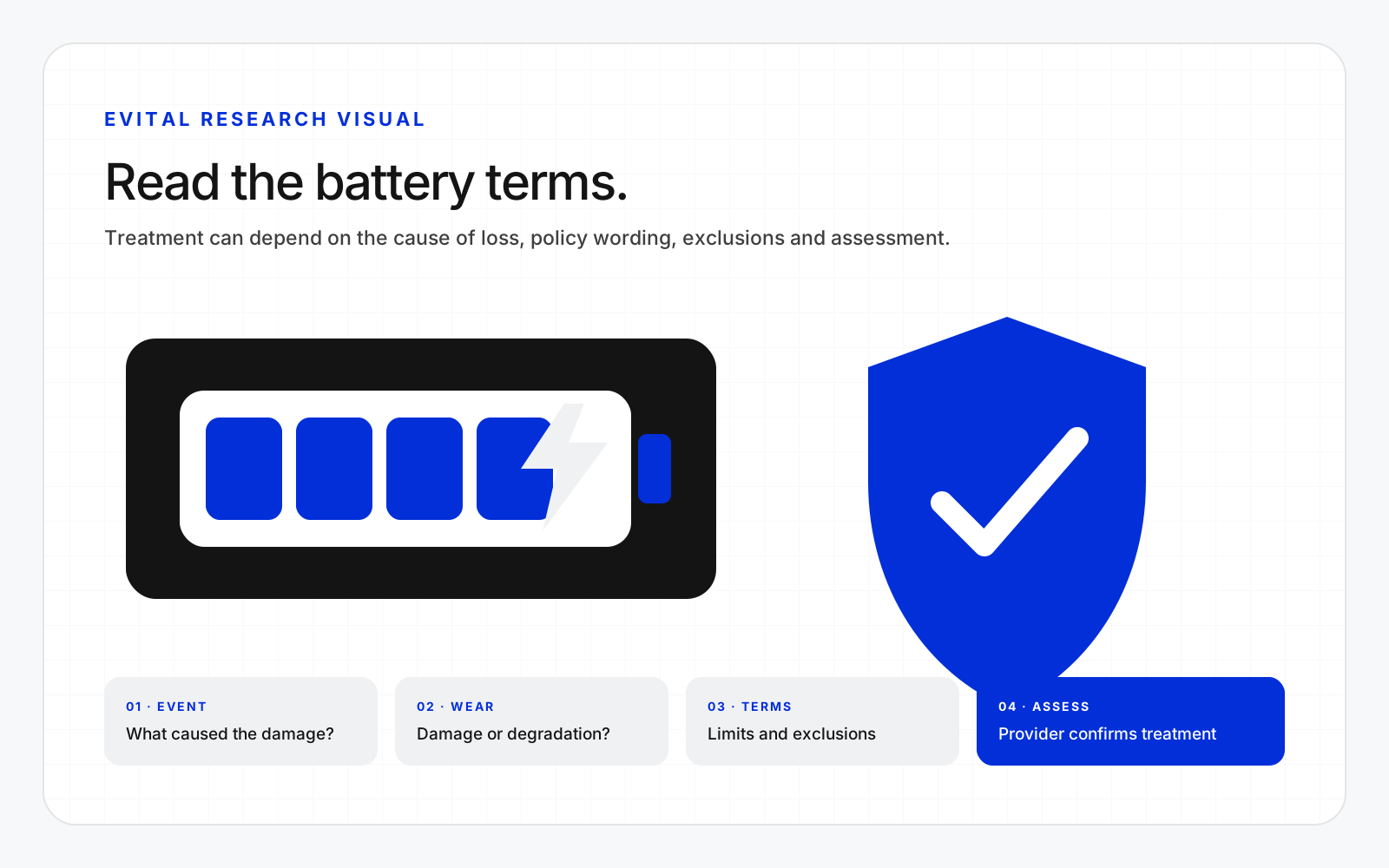
If a high-voltage battery is damaged in an event that is covered by your car insurance, the resulting battery damage may form part of the claim, subject to the policy terms and insurer assessment. By contrast, gradual loss of battery capacity, ordinary wear, defects and mechanical or electrical failure may be treated differently.
Do not assume that the word ‘comprehensive’ means every battery-related event is covered. Australian Government Moneysmart guidance notes that comprehensive motor insurance is broad cover but still has exclusions. The policy documents for the particular product remain the source of truth.
- Identify the cause of the battery problem
- Check whether that event is covered
- Check exclusions and excesses
- Separate accident damage from degradation or defects
- Ask whether warranty or consumer guarantees may also be relevant
After a collision
Why an EV battery may need specialist assessment
A battery pack sits within a high-voltage system. Visible body damage does not necessarily tell you whether the pack, enclosure, cooling system, electrical connections or associated components have been affected. Assessment and repair procedures therefore depend on the vehicle manufacturer, the location and severity of damage and the repairer’s capabilities.
For an owner, the practical point is to avoid making your own assumptions about battery safety after a significant collision, impact, flood or underbody strike. Follow emergency guidance and the vehicle manufacturer’s instructions, then allow the insurer and appropriately qualified repair professionals to assess the vehicle.
Warranty vs insurance
A battery warranty solves a different problem
A manufacturer battery warranty is not a substitute for motor insurance. Warranty terms commonly address defects and may include a battery-capacity condition for a defined time or distance. Motor insurance responds to insured events according to its policy wording.
Australian Consumer Law rights can also exist alongside a manufacturer warranty. The ACCC explains that consumer guarantees apply automatically and cannot be removed simply because a voluntary warranty has expired or has particular conditions. Whether a consumer guarantee provides a remedy depends on the circumstances.
- Insurance: consider whether an insured event caused the damage
- Warranty: check the manufacturer's battery terms and capacity conditions
- Consumer guarantees: may apply independently of a voluntary warranty
- Roadside or service support: may apply to breakdown situations rather than insured loss
Before you buy
Check the battery questions before choosing cover
When comparing policies, ask how the insurer handles high-voltage battery damage, water or flood events, towing after a battery-related incident, repairer selection, genuine or compatible parts, and total-loss assessment. Do not rely on a generic statement that a policy is ‘EV friendly’.
If you are buying an EV, obtain an insurance quote before committing to the vehicle. Australian Government EV guidance specifically recommends checking insurance before purchase because pricing varies by insurer.
Common questions
Frequently asked questions
Is EV battery degradation covered by car insurance?
Do not assume so. Gradual degradation is different from sudden accidental damage and may fall under manufacturer warranty terms, maintenance considerations or exclusions rather than an insured event. Check the specific policy and battery warranty.
What if the battery is damaged in a crash?
If the crash is an insured event, battery damage may be considered as part of the vehicle claim, subject to the policy wording, exclusions, excesses and insurer assessment.
Does a battery warranty replace insurance?
No. A battery warranty and motor insurance address different risks. Warranty terms generally relate to defects or specified battery performance, while insurance responds to covered events under the policy.
Do Australian Consumer Law rights disappear when a battery warranty expires?
Not automatically. The ACCC states that consumer guarantees apply automatically and can continue for a reasonable period depending on the product, independently of a voluntary warranty.
Why can EV insurance be different?
Electric vehicles combine a high-voltage battery, power electronics, connected technology and model-specific repair procedures. Those characteristics can affect repair assessment, parts, labour and replacement decisions, but pricing and cover are determined by each insurer.
What does EV insurance cover?
There is no single EV insurance cover standard. Cover depends on the insurer, policy type, Product Disclosure Statement or other policy wording, selected options, exclusions, limits and eligibility. Check the documents for the specific product before deciding whether it suits you.
Keep learning
Related EVITAL guides
Continue with closely related Australian EV information from the same topic cluster.
Continue your insurance research
Build on this guide with factual EV insurance information.
Explore cover types, policy wording, battery, repair and cost considerations, then verify current product terms directly with a licensed provider.